AI is everywhere right now. New tools, new capabilities, and new promises about doing more with less.
But here's the part that most people are missing.
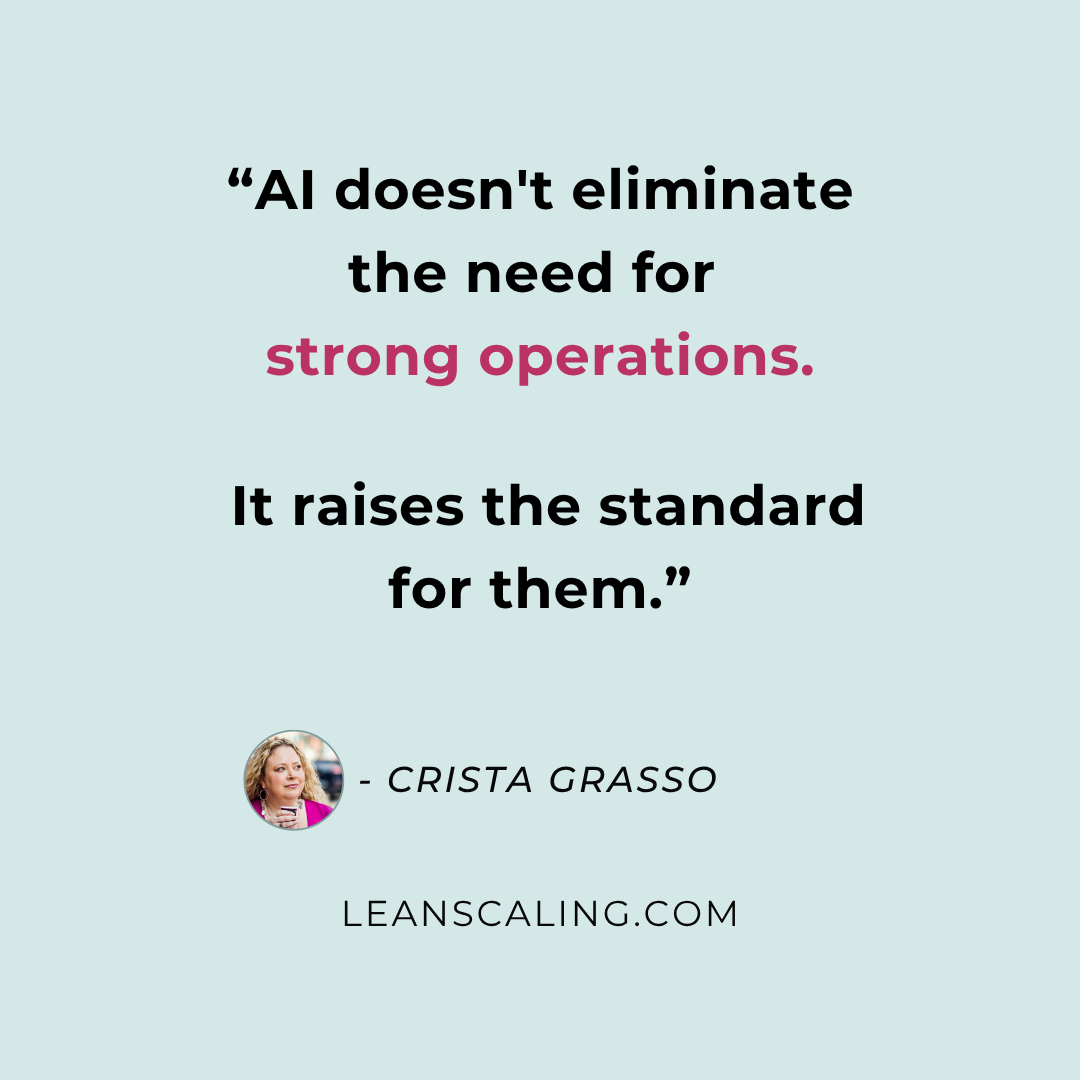
AI does not remove the need for structure. It increases the need for it.
As AI evolves from simple prompts into multi-step agents that can execute work, post content, and interact with systems, the businesses that benefit the most will be the ones that already have clarity around how they operate.
Because AI is not magic.
It performs best when it understands exactly what success looks like.
It is important to know what it actually takes to prepare your business for the future of AI and leaner teams, and why getting your systems in place now will determine how successfully you scale moving forward, including:
- Why AI still requires strong systems
- Preparing for leaner, AI-supported teams
- Creating role success kits for AI
- Avoiding AI slop and generic output
- Defining where AI should and should not be used
- Training AI like a team member
I also unpack this with Jessica D. Maine in episode 275 of the Simplify to Scale Show.
Tune into Episode 275 of the Simplify to Scale Show or keep reading below.
AI Is Shifting from Tool to Team Member
Most people are still using AI like a chat tool. You type a prompt, you get a response and then refine and repeat.
That was the early phase of AI adoption.
But things are now evolving very quickly.
We're now moving into a world where AI agents can:
- Execute multi-step workflows
- Create and publish content
- Update systems and tools
- Support client delivery
- Perform operational tasks
This means AI is no longer just a tool. It is becoming more like a team member.
And just like any team member, AI needs clear expectations, defined outcomes, strong onboarding, proper training, guardrails and boundaries.
Without these in place, you don't get to enjoy the efficiency that is supposed to come with AI.
You get confusion, inconsistency, and more work cleaning things up.
This is why preparing your business for AI is not about learning prompts. It's about strengthening your operational foundation.
Why Systems Matter More in an AI-Driven Business
There is a common belief that AI reduces the need for systems. Whereas in reality, the opposite is true.
If you want AI to produce high-quality results, you need:
- Defined processes
- A clear brand voice
- Guiding principles
- Decision frameworks
- Clearly defined outcome expectations
Otherwise, AI will default to generic outputs, and generic outputs do not build strong brands.
When AI is given vague direction, it fills in the gaps with widely available patterns. That leads to content and execution that feels interchangeable instead of differentiated.
To leverage AI effectively, your inputs need to be:
- Specific to your brand
- Aligned with your values
- Clear about desired outcomes
- Structured around how your business actually operates
The quality of your inputs determines the quality of your outputs.
This has always been true with AI, and it becomes even more important as AI agents begin executing work independently.
The Hidden Risk of AI Without Operational Clarity
Another risk that often gets overlooked is that AI can create more noise if it is not guided properly.
You've likely seen examples of generic AI content, repetitive messaging, over-templated communication and content that lacks real thought leadership.
As AI agents begin creating and publishing content automatically, this risk increases.
So without clear guidance, AI can:
- Produce content that doesn't reflect your expertise
- Create inconsistent messaging
- Dilute your brand positioning
- Generate unnecessary work reviewing and correcting outputs
The goal is not to let AI create for you. The goal is to have AI work with you and amplify your thinking.
That distinction changes everything.
When AI is guided by strong operational clarity, it becomes a strategic assistant and a capacity builder (instead of a tool that requires constant oversight).
Treat AI Like You Would a New Hire
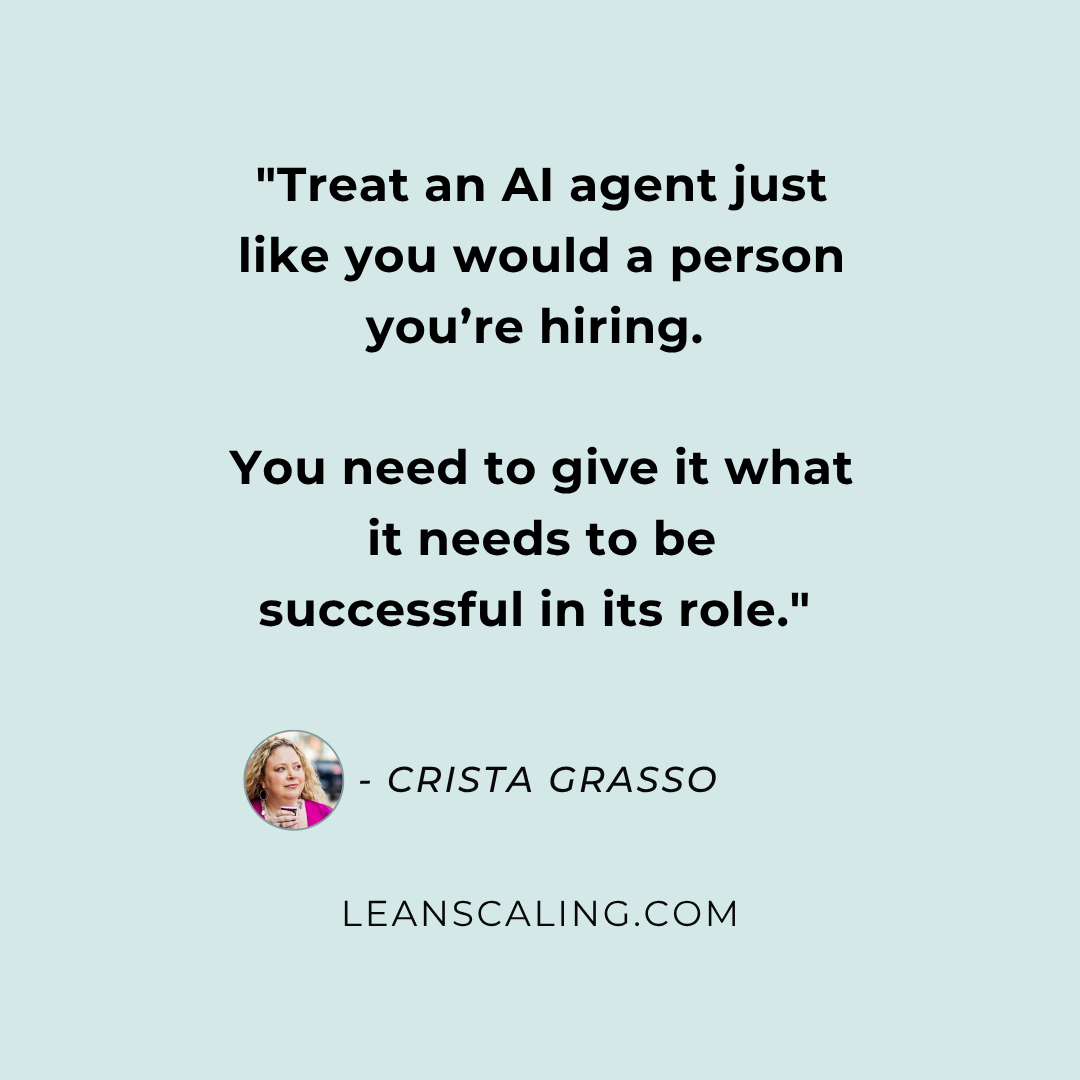
One of the simplest ways to prepare your business for AI is to think about it like hiring a new team member.
If you were hiring someone, you would typically provide:
- A clear role description
- Success metrics
- Training materials
- Process documentation
- Brand guidelines
- Communication expectations
AI requires the same structure.
This is where Role Success Kits become especially valuable.
A Role Success Kit defines:
- What the role is responsible for
- What success looks like
- Key processes
- Guardrails and constraints
- Decision authority
- Metrics for performance
Even if AI is handling multiple responsibilities, each function should have clarity around expectations. This allows AI to operate with direction rather than guesswork.
Defining What AI Should and Should Not Do
Another important consideration is deciding where AI fits within your team structure.
Many people treat AI as a catch-all for tasks they do not want to handle but approach creates problems.
Instead, you need to define:
1. Where AI adds the most value
Such as repetitive tasks, data organization, drafting and iteration, workflow automation and operational support
2. Where human involvement remains critical
Such as strategic decision-making, relationship building, thought leadership, brand positioning and sensitive client interactions
It is also important to define boundaries.
Some businesses choose to limit confidential data use, client information, strategic planning discussions and internal leadership conversations.
Being intentional about these decisions protects both your business and your clients.
AI Efficiency Depends on Clarity
Research suggests that professionals who use AI for less than 7 percent of their day often see the highest efficiency gains.
This is because they know exactly what they need, they use AI with intention, they focus on outcomes, and they avoid aimless experimentation.
When systems are unclear, AI usage increases, but efficiency decreases.
This is because you spend more time prompting, refining outputs repeatedly and searching for direction, instead of executing.
Clear systems allow AI to become targeted and effective.
Without clarity, AI becomes another layer of complexity.

The Future of Leaner, AI-Enabled Teams
AI is not replacing teams. It is reshaping them.
The future of small business teams will likely include:
- Leaner team structures
- AI-supported execution
- Humans focused on strategy and leadership
- Increased ownership and accountability
This shift allows businesses to scale more efficiently, reduce operational bottlenecks, increase profitability and improve sustainability.
But this only works when operations are well designed.
Without strong operational foundations, AI amplifies inefficiencies instead of solving them.
Preparing Your Business for AI-Driven Scale
If you want to prepare your business for the future of AI and leaner teams, focus on these foundational steps:
- Clarify your brand voice and guiding principles
- Document your core processes
- Define role success expectations
- Establish decision frameworks
- Identify where AI fits into your team structure
- Set boundaries for AI usage
- Align AI outputs with strategic outcomes
When these elements are in place, AI becomes a strategic advantage rather than a distraction.
You create an environment for stronger execution, clearer communication, scalability, and more sustainable growth.
And most importantly, you position your business to adapt as AI continues to evolve.
The businesses that prepare now for AI will be positioned to lead.
The ones that wait may find themselves trying to catch up.
If you're ready to learn how to start building the operational foundation that supports scalable growth and AI-enabled teams, I invite you to register for the next Breaking the CEO-Centricity Ceiling, a Free Live Workshop for Forward-Thinking Founders of 7 - 8 Figure Service-Based Businesses.
You'll learn how to best leverage AI and shift your business to get out of the day-to-day.
Register now at leanscaling.com/ceo-workshop

by Crista Grasso
Crista Grasso is the Founder of Lean Scaling Co and Strategic Ops Institute and the host of the Scale Differently.
She developed the Lean Scaling System™ to make scaling simple and sustainable for service-based businesses in the messy middle of $1M - $10M. She specializes in elevating the founder out of daily operations and into visionary leadership and in certifying fractionals and consultants to be able to effectively and strategically scale the businesses they partner with.