There are seasons in business when the question is no longer how to grow what you've built.
The question becomes whether what you've built is still aligned with who you are becoming.
Many business owners reach a point where the strategies, offers, positioning, or even the role they play in their business no longer feel quite the same as they once did.
Sometimes this happens gradually and other times it arrives all at once after a major market shift, a significant life change, or a period of deep reflection.
What makes these seasons challenging is that they are rarely just business decisions.
They are identity decisions too.
As the business evolves, the founder often evolves alongside it.
And while that process can feel unsettling, it can also create the space for some of the most meaningful growth you'll experience as a business owner.
Learning the following can help you effectively shift into what's next without losing everything you've already built:
- How to recognize when you've outgrown your current business
- What disruption is showing you (it's not always a bad thing)
- How to handle the emotional rollercoaster of business transitions
- The best ways to effectively communicate changes with your clients
I also discuss this in episode 283 of the Simplify to Scale Show.
Tune into Episode 283 of the Simplify to Scale Show or keep reading below.
Why So Many Founders Are Experiencing Identity Shifts Right Now
Over the past several years, many business owners have found themselves reevaluating assumptions that once felt stable because:
- Markets have changed
- Buyer behavior has shifted
- New technologies have accelerated the pace of change
- Long-standing approaches that once produced predictable results often require rethinking and adaptation
When familiar patterns stop producing familiar outcomes, something interesting happens.
The routines that once operated almost automatically begin to break down.
Questions that may have remained beneath the surface suddenly move front and center.
You begin examining things that previously felt settled.
You start considering not only how your business operates, but also whether you're building the business you still want.
For some people, this reflection leads them toward a different path altogether.
For others, it strengthens their commitment to entrepreneurship while changing how they want to show up within it.
And for many, it opens the door to possibilities they had been considering for years.
Identity Evolution Often Begins With Disruption
Business owners are often accustomed to solving problems.
When something stops working, their natural instinct is often to find a way to make it work again.
Yet disruption can offer something more valuable than a solution.
It can create an opportunity to pause long enough to ask different questions.
Questions such as:
- Is this still the work I want to be doing?
- Is this the role I want to play in my business?
- Does my current business model support the future I want to create?
- If I were designing this from scratch today, would I build it the same way?
These questions often mark the beginning of an identity evolution.
Not because something has gone wrong but because something new is trying to emerge.
The Hidden Part of Business Evolution Nobody Talks About
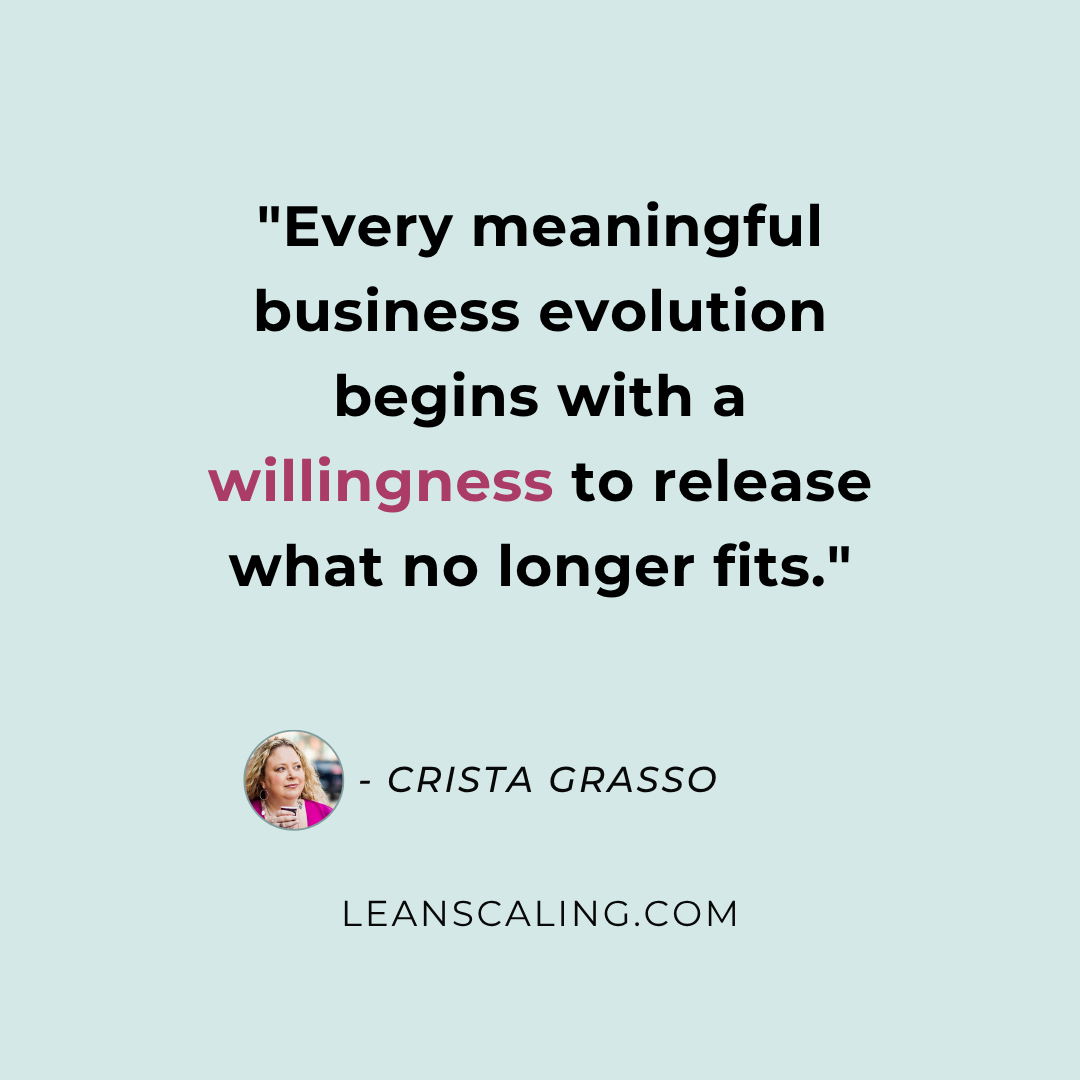
Even when a change feels exciting and aligned, there is often a process of letting go that accompanies it.
This can feel surprising.
Many people expect grief to accompany loss, but fewer people expect it to accompany growth.
Yet whenever we release a version of ourselves, a role we've held, or a way of operating that has become familiar, there is often a period of adjustment.
The previous version of the business may have represented years of effort, learning, relationships, and experiences.
But moving forward does not erase the significance of what came before.
It simply acknowledges that it may no longer be the destination.
Giving yourself space to process that transition matters.
Not because you need to dwell on the past, but because acknowledging what you're leaving behind often creates greater clarity around what you're moving toward.
How to Communicate an Identity Shift to Existing Clients
One of the biggest concerns many business owners have during a transition is how their current clients will respond.
- Will they understand?
- Will they support the shift?
- Will they feel uncertain about what comes next?
In most cases, the strongest approach is transparency paired with leadership.
Clients who work closely with you are often invested in your growth.
They have a relationship with you beyond the individual services you provide.
That creates an opportunity for an honest conversation.
Rather than framing a shift around frustration or disappointment, frame it around vision.
Share what you've learned. Share what you've become increasingly passionate about.
Share what you're seeing in the market and why you believe this evolution allows you to create greater value moving forward.
When clients understand the bigger picture, they often gain confidence in the direction you're heading.
Your willingness to evolve becomes an example of the same strategic thinking they are working to develop within their own businesses.
Lead With Possibility
The energy behind the message matters.
People tend to respond differently when they hear someone stepping into a new chapter versus someone trying to escape an old one.
Focus on the opportunities ahead.
Focus on what this evolution allows you to create.
Focus on how it positions you to better support the people you serve.
That perspective helps clients see the change through the lens of possibility rather than uncertainty.
How to Introduce a New Direction to Prospective Clients
Many founders assume everyone notices every change they make.
In reality, most people are focused on navigating their own businesses and lives.
While your shift may feel significant internally, prospective clients often encounter you for the first time through the lens of what you're doing today.
This creates flexibility in how you communicate your evolution.
Some business owners choose to make the transition highly visible.
They invite their audience into the journey, share what prompted the shift, and use the change as a conversation starter.
Others simply begin talking about the work they are doing now.
Both approaches can be effective.
The right choice depends on what feels aligned with your personality, communication style, and business goals.
The most important thing is not the announcement itself.
It's the clarity behind the message.
When people understand who you help, how you help them, and why your work matters, they are far more interested in the value you provide than the path that brought you there.
Giving Yourself Permission to Build What Comes Next
One of the greatest gifts hidden inside a season of change is permission.
- Permission to reconsider assumptions
- Permission to question old goals
- Permission to redefine success
Sometimes the next evolution is a modest shift in focus such as a small adjustment in positioning, a refinement of your services or a deeper commitment to a specific area of expertise.
Other times the change is far more significant, like a new business model, a new audience, a new role or a new vision altogether.
Neither is more valid than the other.
What matters is creating enough space to hear what is calling you forward.
That often requires stepping back from immediate demands long enough to zoom out and look at the bigger picture.
You need to look beyond what is working and what is profitable, but also consider what feels meaningful, sustainable, and aligned with where you want to go.
Your Next Step in Navigating a Business Identity Evolution
Business identity evolution is a natural part of long-term growth.
The founders who continue building meaningful businesses are rarely the ones who stay exactly the same.
They are the ones who remain willing to evolve alongside the businesses they lead.
As you think about your own next chapter, consider these questions:
- What aspects of your business still feel deeply aligned?
- What parts may have outgrown their purpose?
- What opportunities keep resurfacing in your thoughts?
- What role do you want to play in your business moving forward?
- What would become possible if you gave yourself permission to pursue that vision?
The answers do not need to arrive all at once.
Sometimes the most important step is creating space for the conversation.
If you're exploring what comes next in your business and looking for a way to step more fully into your role as a strategic leader, take time to evaluate whether your current business model, team structure, and operating systems support the future you're trying to create.
The clearer you become on your next evolution, the easier it becomes to build the bridge between where you are today and where you want to go next.

by Crista Grasso
Crista Grasso is the Founder of Lean Scaling Co and Strategic Ops Institute and the host of the Scale Differently.
She developed the Lean Scaling System™ to make scaling simple and sustainable for service-based businesses in the messy middle of $1M - $10M. She specializes in elevating the founder out of daily operations and into visionary leadership and in certifying fractionals and consultants to be able to effectively and strategically scale the businesses they partner with.